The history of the Rorbu

Even before the year 900 AD, the sagas tell us of boats from along the coast being equipped for the journey to Lofoten and the winter cod fishing season. In addition to the ordinary “home” fisheries, tales were told all along the coast of the extremely bounteous winter fishery off the Lofoten Islands.

People travelled for days and even weeks in open rowing boats and sailing boats to take part in the abundant fisheries of Lofoten, throughout the entire winter. This created a need for accommodation. We have little knowledge of how this need was met during the first centuries, but from the sagas, we know that in the early 1100's, King Øystein decided that "rorbus" should be built for the visiting fishermen in Lofoten. This tells us something of how important this fishery was for the country's economy even at such an early date.

The Word "Rorbu"
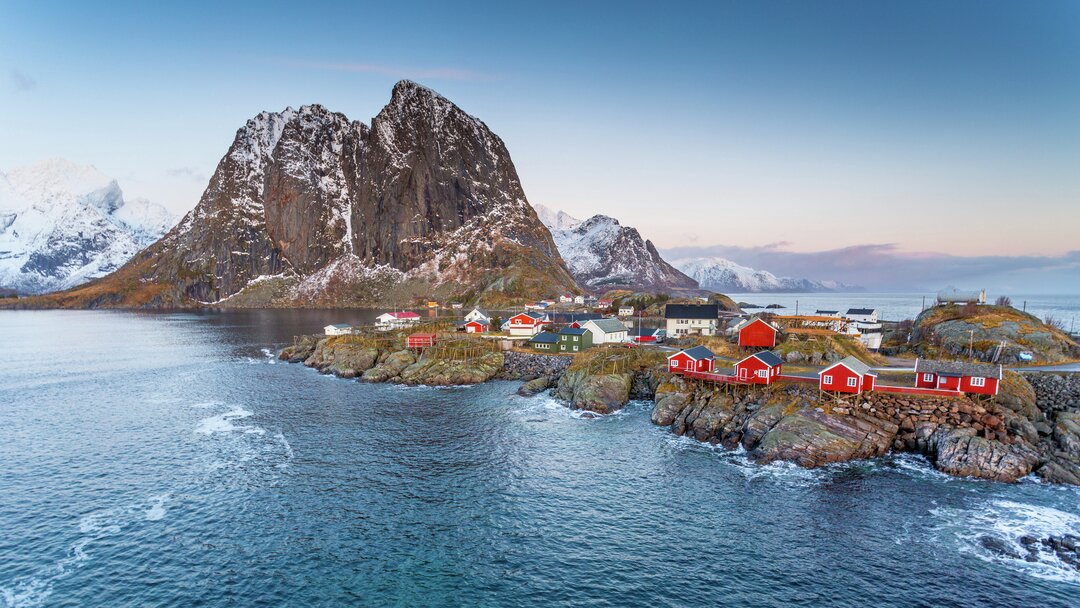
RORBU? What are the origins of the word? "Bu" means a (small) dwelling, and is derivative of the Norwegian word, "bo", to live in. So: A tiny house to live in. But the word is also used in certain other contexts, e.g. "redskapsbu" - a "house" where tools are kept. The first syllable of the word RORBU derives from the Norwegian word "ro", to row. For centuries the fishermen came in rowing boats, and it was not until the early 1900's that the fishing boats were equipped with engines. One literally "rowed" out to the fishing grounds. Even after three generations of motor boats, the Norwegian for "row out to the fishing grounds" is still the vernacular for taking part in the fisheries. A "rorbu", then, is a house where the fishermen lived when they rowed out to the fishing grounds.

New Use and Modernisation
Around 1960, when hundreds of rorbus were empty all year round and many had been demolished or blown down by the winter storms, some of the better cabins were let out to tourists for the first time. During a twenty year period, the amount of tourists wishing to stay in rorbus increased, and the owners had their rorbu cabins restored and modernized. The old main part could often be left as it was, whereas the parts that were used to store tackle and other equipment have been insulated against the cold and furnished with showers, toilets and one or more additional bedrooms. Whereas previously it was necessary to carry water to the rorbus, today, practically all the cabins have hot and cold running water.

"Sjøhus" - Quayside Rooms
In the fishing villages we also find larger buildings where the fishermen's catch was landed. These quayside fish halls, were normally built with two to four floors and here too, rooms were furnished to accommodate the land-based workers in the fishing industry and some of the boat crews. Since much of this accommodation was used by fishermen, these are sometimes also referred to as rorbus. In order to distinguish this type of accommodation from the traditional, detached rorbus, the term SJØHUS is used about these larger buildings. The accommodation offered in these "sjøhus", or quayside rooms, is often of a more modern fashion than the old cabins, and in many cases these accommodation units are more spacious than the traditional rorbus. In some of the "sjøhus" the guests share a common kitchen and lounge.

Available adspace
330 X 110px
Available adspace
330 X 110px